
Construction Mini Cranes
360-Degree Mini Construction Crane: Reach and Setup
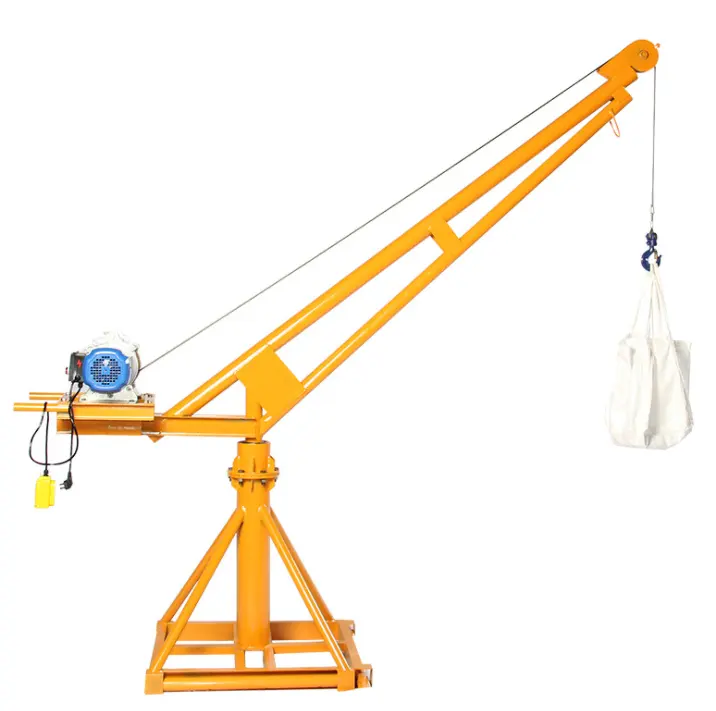
Compact material handling for rooftop, window and restricted-access locations.
| Boom rotation | 360 degrees |
|---|---|
| Drive | Electric hoist |
| Frame | Alloy steel |
Product role and applications
This compact crane combines vertical hoisting with boom rotation to position materials around a fixed support. The rotating frame changes the direction of the lift; the electric hoist raises or lowers the hook. It is a material-handling arrangement, distinct from a platform intended to carry personnel.
Structure and compatibility
The alloy-steel frame and double-bearing shaft support the rotating assembly. The mounting connection must transmit the load to a suitable supporting structure. Rotation clearance and load capacity at the required reach are separate checks; a full rotation angle does not establish the allowable load at every position.
Features in practical use
Rotation helps reposition the hook around the support without describing a new vertical lift. Plan the swept area of the boom and the space occupied by the load separately. Compact frame dimensions do not remove the need for clearance around the moving assembly.
Specifications
| Boom rotation | 360 degrees |
|---|---|
| Drive | Electric hoist |
| Frame | Alloy steel |
| Capacity and reach | Request the configuration-specific load chart |
Key features
- Double-bearing rotating shaft
- Compact support frame
- Confirm load, lifting height and mounting arrangement
Technical guide
Configuration explained
Rotation describes movement, not a uniform lifting envelope. The permitted load depends on reach, support and the specified configuration. Describe the complete swing path and landing position. A rotation statement must not be used instead of a configuration-specific load chart or support assessment.
- Supporting surface or structure
- Crane frame and mounting
- Boom reach and lifting path
- Load and attachment
Check the rotating boom envelope
The listed 360-degree boom and double-bearing shaft make rotation a central configuration question. Show the transfer opening, mounting location and available turning space, together with the load and required reach.
Information to include in your inquiry
Describe both the pickup and landing positions, including obstacles throughout the rotating path. Submit the load dimensions and required reach together. The stated rotation range does not establish lifting capacity at every boom position; request the configuration-specific load chart.
What changes the buying decision
Full rotation describes the slewing movement, not a constant lifting capacity throughout the work area. Provide the required radius, lifting height and landing position. The load chart and mounting arrangement determine the usable duty; nearby structures and the load path also need clearance within the intended rotation envelope.
Questions and answers
Does 360-degree rotation mean the rated load is unchanged at every reach?
Do not assume a constant capacity. Request the load chart for the selected boom position and supporting arrangement.
What site information is needed for the crane swing path?
Show the pickup and landing positions, required reach, nearby obstacles and supporting arrangement. Rotation alone does not establish clearance.
Does an electric hoist determine the crane power connection?
Request the supply requirements of the actual hoist and controls. Confirm voltage, phase and frequency before selecting the electrical arrangement.