
Glass Lifting Equipment
Mobile Glass Vacuum Lifter: 400, 600 and 800 kg Options
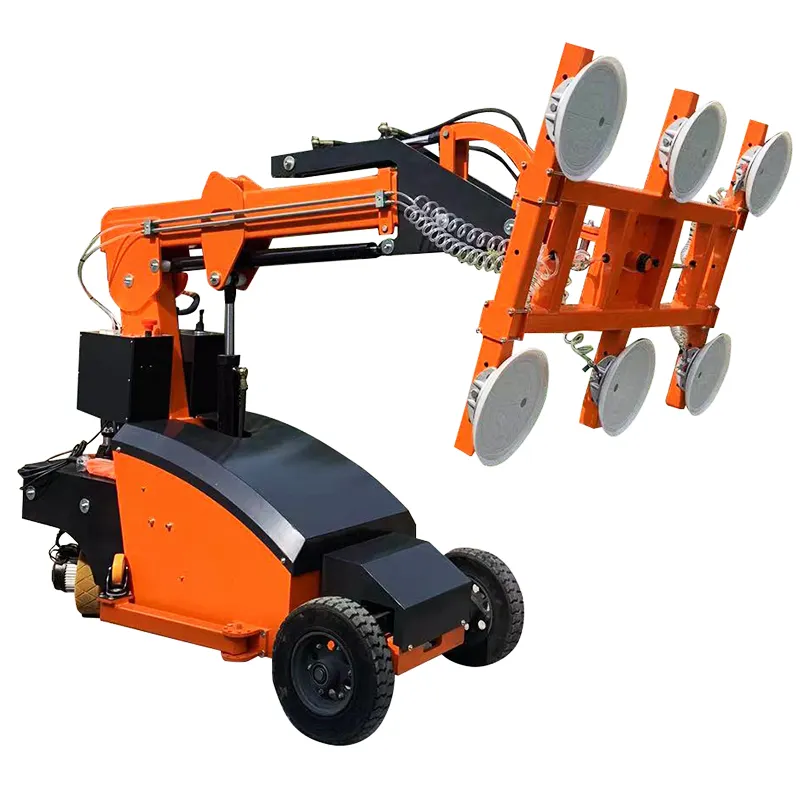
Battery-powered handling for suitable glass and non-porous panels.
| Capacity options | 400 / 600 / 800 kg |
|---|---|
| Power | Battery with built-in vacuum pump |
| Rotation | Manual or powered by configuration |
Product role and applications
A mobile vacuum lifter combines panel gripping with movement and positioning. Suction pads hold a suitable surface while the chassis brings the panel toward its installation or handling position. Workpiece dimensions, center of gravity and the required orientation matter alongside weight when choosing among the listed capacity options.
Structure and compatibility
The battery supplies the vacuum pump, while the pad layout forms the contact interface with the workpiece. Rotation and tilt are configuration-dependent movements, not one combined specification. A capacity label for glass does not prove suitability for porous, textured or differently coated panels without an assessment of sealing and support.
Features in practical use
Pad positioning distributes contact across the panel, while chassis movement brings the held workpiece toward its destination. Compare the full route, including turns and the final placement orientation. A panel that can be gripped may still be too large for the available access path.
Specifications
| Capacity options | 400 / 600 / 800 kg |
|---|---|
| Power | Battery with built-in vacuum pump |
| Rotation | Manual or powered by configuration |
| Tilt | Up to 180 degrees on selected models |
Key features
- Confirm material, surface and panel dimensions
- Suction-pad layout matched to the workpiece
- Mobile chassis with rubber tires
Technical guide
Configuration explained
Panel dimensions, center of gravity and placement orientation affect the handling arrangement. Pad contact and surface sealing must be suitable as well. Check turns and final positioning along the route; successful gripping alone does not prove that a large panel can pass through the available opening.
- Handling interface or chassis
- Vacuum supply and monitoring
- Pads and surface contact
- Panel and placement route
Specify the workpiece before the capacity
This range lists 400, 600 and 800 kg options for compatible glass and non-porous panels. Surface finish, dimensions and pad layout influence suitability. Rotation may be manual or powered; the stated tilt option applies only to selected models.
Information to include in your inquiry
Send the panel dimensions, weight, surface finish and required final orientation. Describe the route and clearance at the installation point. Pad arrangement, rotation and tilt should be checked for the actual workpiece rather than selected from capacity alone.
What changes the buying decision
Panel weight alone is insufficient for vacuum-lifter selection. Dimensions and centre of gravity affect positioning, while surface texture, coatings and porosity affect suction compatibility. Describe the lifting orientation and installation clearance, and distinguish manual rotation from powered movement when comparing the available configurations.
Questions and answers
Can the same pads handle every panel material?
No. Provide the actual material and surface condition for review. Do not assume porous, textured or coated materials are compatible without checking the proposed sealing arrangement.
Is the listed 180-degree tilt available on every capacity option?
No universal combination is published. Confirm tilt, rotation and capacity together for the exact proposed model.
What should be checked along the panel transport route?
Provide panel dimensions and orientation, doorway clearances, turns, floor conditions and the final placement position. Weight alone is insufficient.