

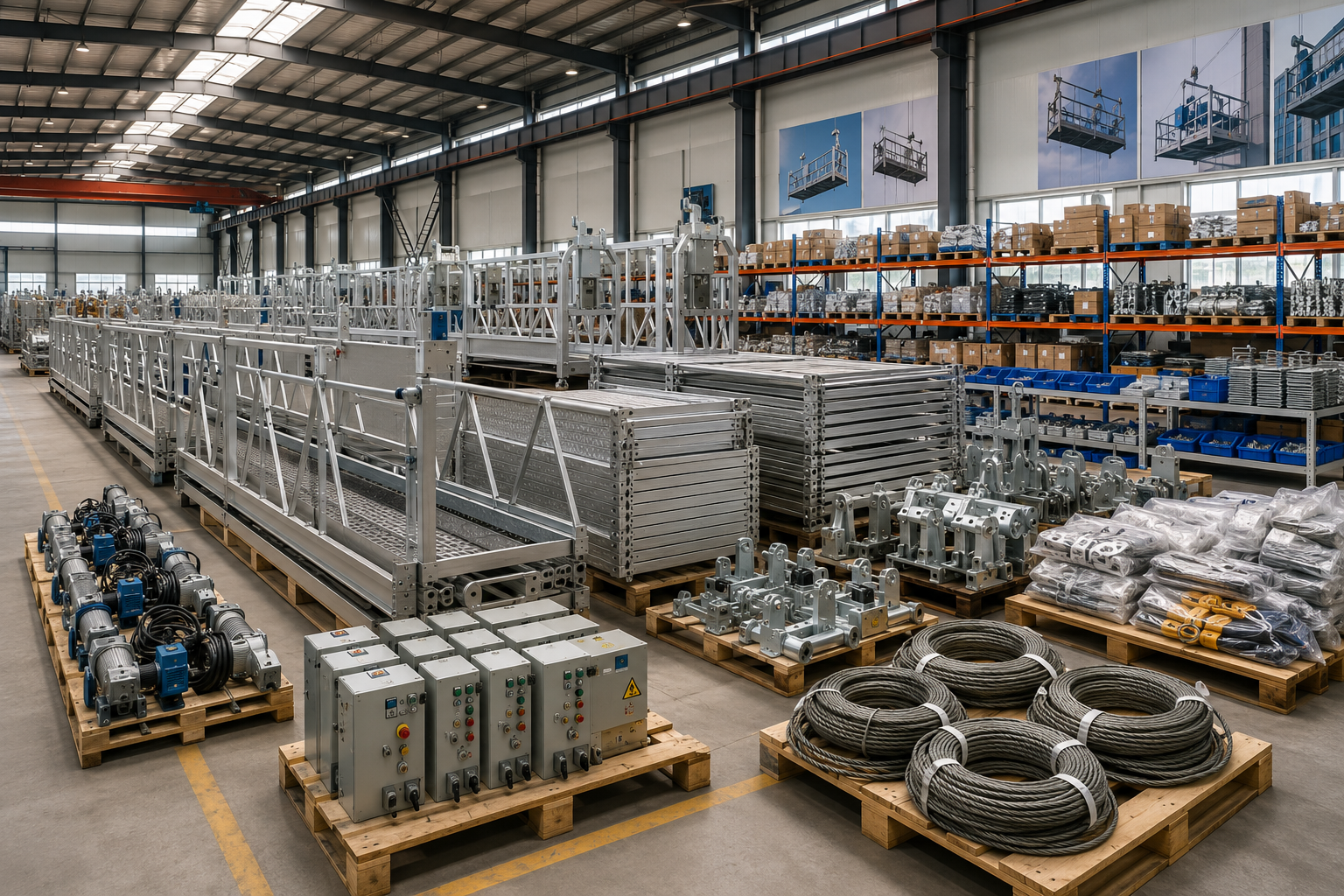
An electric suspended platform—also known as a suspended working platform or gondola suspended platform—is a motorized, overhead-access aerial work platform used to safely position workers and equipment at height. Suspended from roof-mounted rigging systems on buildings or structures, it serves professionals in construction, façade maintenance, window cleaning, glass curtain wall installation, and exterior painting—especially on high-rise and complex buildings. It solves critical challenges of traditional scaffolding: slow setup, limited mobility, and restricted access to irregular façades—delivering faster deployment, precise vertical positioning, and enhanced worker safety.
Key Benefits of Electric Suspended Platforms
1. Повишена ефективност на работата
Electric suspended platforms eliminate time-consuming scaffolding assembly and disassembly. With smooth, quiet electric hoisting and real-time height adjustment, teams access hard-to-reach zones quickly—accelerating tasks like façade cleaning, glass installation, and repair cycles without compromising stability.
2. Подобрени функции за безопасност
These platforms include standard safety mechanisms such as emergency stop buttons, overload protection, automatic braking, and fall-arrest anchor points. All comply with internationally recognized safety standards for suspended access equipment (e.g., ISO 16430, EN 1808), helping reduce fall risk and support safe work-at-height protocols.
3. Adaptability Across Building Types
Whether applied to straight-edged skyscrapers, curved façades, or irregular architectural forms, electric suspended platforms are engineered for flexibility. Adjustable suspension points, modular platform lengths, and variable load configurations allow customization per project geometry and access requirements.
4. Broad Industry Applications
- Façade cleaning & washing (glass, stone, metal surfaces)
- Exterior painting and protective coating application
- Glass curtain wall and cladding panel installation
- Building inspection, maintenance, and repair
- Construction support for high-level structural work
Как да изберем правилната електрическа окачена платформа
1. Товароносимост
Select a platform rated for total working load—including personnel, tools, materials, and environmental factors (e.g., wind load). Always verify certified load limits per manufacturer documentation.
2. Platform Dimensions & Workspace
Ensure usable deck area supports tool staging, worker movement, and material handling. Consider minimum clearance requirements around edges and compatibility with building parapets or roof obstructions.
3. Safety Certification & Compliance
Confirm the unit meets applicable regional and international standards (e.g., CE marking for EU, AS/NZS 1657 in Australia/NZ, or local occupational safety regulations). Request third-party test reports where available.
4. Control System & Usability
Modern units feature intuitive control panels, wireless remote operation, and status indicators (e.g., load, height, tilt). Prioritize systems with dual-control redundancy and clear operator training support.
Common Applications by Sector
Construction
Used for high-level glazing, structural inspections, and façade anchoring—reducing reliance on crane-assisted lifts or temporary towers.
Cleaning & Maintenance
Enables systematic, rope-free access for routine and deep-cleaning of glass, metal, and composite façades—improving consistency and reducing downtime.
Façade Installation
Provides stable, vibration-minimized positioning for precision placement of heavy cladding panels, minimizing manual handling risks and alignment errors.
Painting & Coating
Offers uniform, hands-free elevation for spray or brush application across large vertical surfaces—supporting even coverage and reduced overspray.
Frequently Asked Questions (FAQ)
What is an electric suspended platform?
An electric suspended platform is a motor-driven, overhead-suspended work platform used to safely elevate workers and equipment for high-rise tasks—including façade cleaning, construction, and maintenance.
How does it differ from a manual or hydraulic suspended platform?
Electric platforms use quiet, energy-efficient motors for precise, stepless height control—ideal for urban environments and sensitive sites. They typically require less on-site power infrastructure than hydraulic alternatives and avoid fluid-related maintenance.
Are electric suspended platforms suitable for irregular or historic buildings?
Yes—when paired with custom rigging solutions and adjustable suspension frames, they accommodate non-standard roof layouts, narrow setbacks, and heritage façade constraints—subject to site survey and engineering review.
Do I need operator certification to use one?
In most jurisdictions, operators must complete certified training aligned with local work-at-height regulations (e.g., OSHA 1926 Subpart M in the U.S., LOLER in the UK). Manufacturer-specific instruction is also required.
Next Steps
If you’re evaluating an electric suspended platform for an upcoming project, consult technical specifications, request compliance documentation, and confirm compatibility with your building’s structural and rooftop conditions. BuildingLift provides engineered suspended working platforms—including gondola suspended platforms—designed for safety, adaptability, and long-term reliability.
Related ZLP Suspended Platform Options
For project quotation and model selection, compare our ZLP630 electric suspended platform, временни окачени платформи, and окачена работна платформа за почистване на прозорци.
 Previous Post
 Next Post